Route 66
Luís Vasconcelos
29.11.2025 :: 24.01.2026
Wednesday to friday 03:00 pm - 07:00 pm, saturday till 08:00 pm
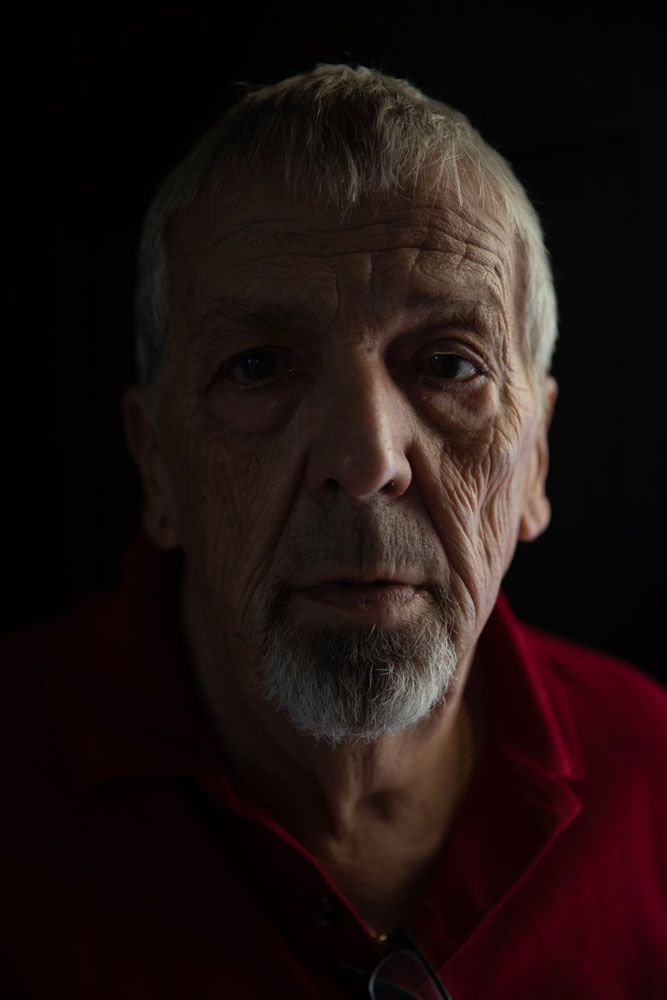
Luís Vasconcelos and I were meant to cross paths. Born in the middle of the last century, we shared five years of exile in Paris before returning to Lisbon after the Revolution of 25 April. History placed us side by side.
Comrades in our professions, the camera and the pen often brought us together. For a moment, we were famous. In Macau, during the final days of Portuguese sovereignty, the notorious bandit Dente de Ouro had just been arrested. The Hong Kong newspapers – each with circulations of over a million – published a photograph of us striding confidently down the street. The caption read: “PJ inspectors arrive from Lisbon.”
Another time, we created what I still consider a masterpiece. During the Kosovo war, we were having coffee in Prizren with our interpreter. Our Muslim driver stared at her with barely concealed hostility. Then a blond peasant approached us with an offer: he would take us to his village. “She goes, he doesn’t,” he said, pointing at the driver. We agreed. We needed her to translate, and we were tired of him.
We rode in our host’s cart to what felt like an eagle’s nest. The village was enclosed by walls, like a smugglers’ fortress. From the Sharr Mountains, Macedonia and Albania lay spread out beneath us. We were in the company of Kosovo’s most complex ethnic group: the Gorani – blond like the Serbs, Muslim by choice. A dangerous contradiction, and one of the roots of war.
On the return journey to Prizren, along a narrow goat track, Luís was asleep – or so I remember – and I shouted for the cart to stop. Today, Luís insists he wasn’t asleep and that I didn’t shout. What matters is that we stopped. Before us unfolded a biblical scene: two white horses; an old man with a face carved by knives; two young blond women; three babies; and our guide, wearing a garish, multicoloured Balkan waistcoat that seemed to expose the deepest fears of his people. Are they still there?
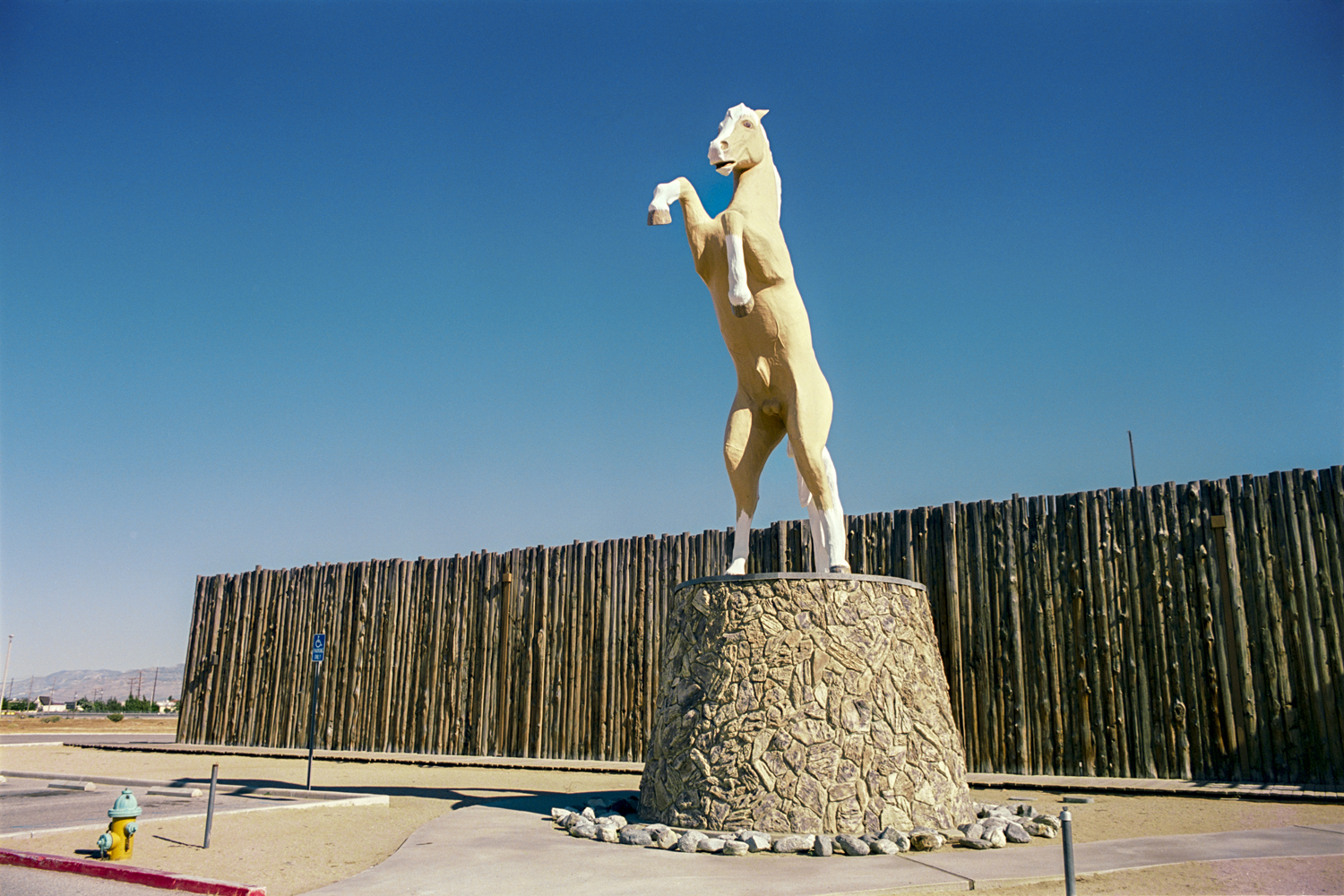
Some time ago, Luís Vasconcelos realised that the most famous road in the world – Route 66 – was approaching its centenary, in 2026. A sign that cuts diagonally across the United States for four thousand kilometres, condensing an entire country into a single line. A solitude waiting to be hunted in photographs. I stayed behind to write the captions – easy enough – while Luís set out to prove how exhilarating a strip of asphalt can be.
It begins with a man wearing a tie fluttering in the wind, beneath the sign “Begin Route 66”. Chicago rises behind him, the windy city framed by skyscrapers. The road crosses Kansas, the state of boredom that The Wizard of Oz transformed into illusion, where buildings sprout baroque towers like something out of the Emerald City.
Soon the grain plains emerge, punctuated by a vast barn that only the attentive will notice. Route 66 is not for the distracted. It jolts us awake with its warnings. “Midpoint: Chicago 1,139 miles; Los Angeles 1,139 miles.”
The place is Adrian, Texas. “When you’re here, you’re halfway there.” How comforting it would be to say that, and believe it, more often in life. Last year the village had 135 inhabitants. This year, only 130. The loneliness of Route 66 deepens. The road itself never stops rolling, but in its villages the stop sign feels unnecessary. Why stop when no one is coming?
Route 66 insists. “The place where East meets West,” announces a sign. The photographer, fully aware of the power of images, illustrates the idea with a crossing of eras: a Studebaker – 1950s station wagon, wooden doors recalling Atlantic forests – passing a Cadillac convertible born of Pacific beaches.
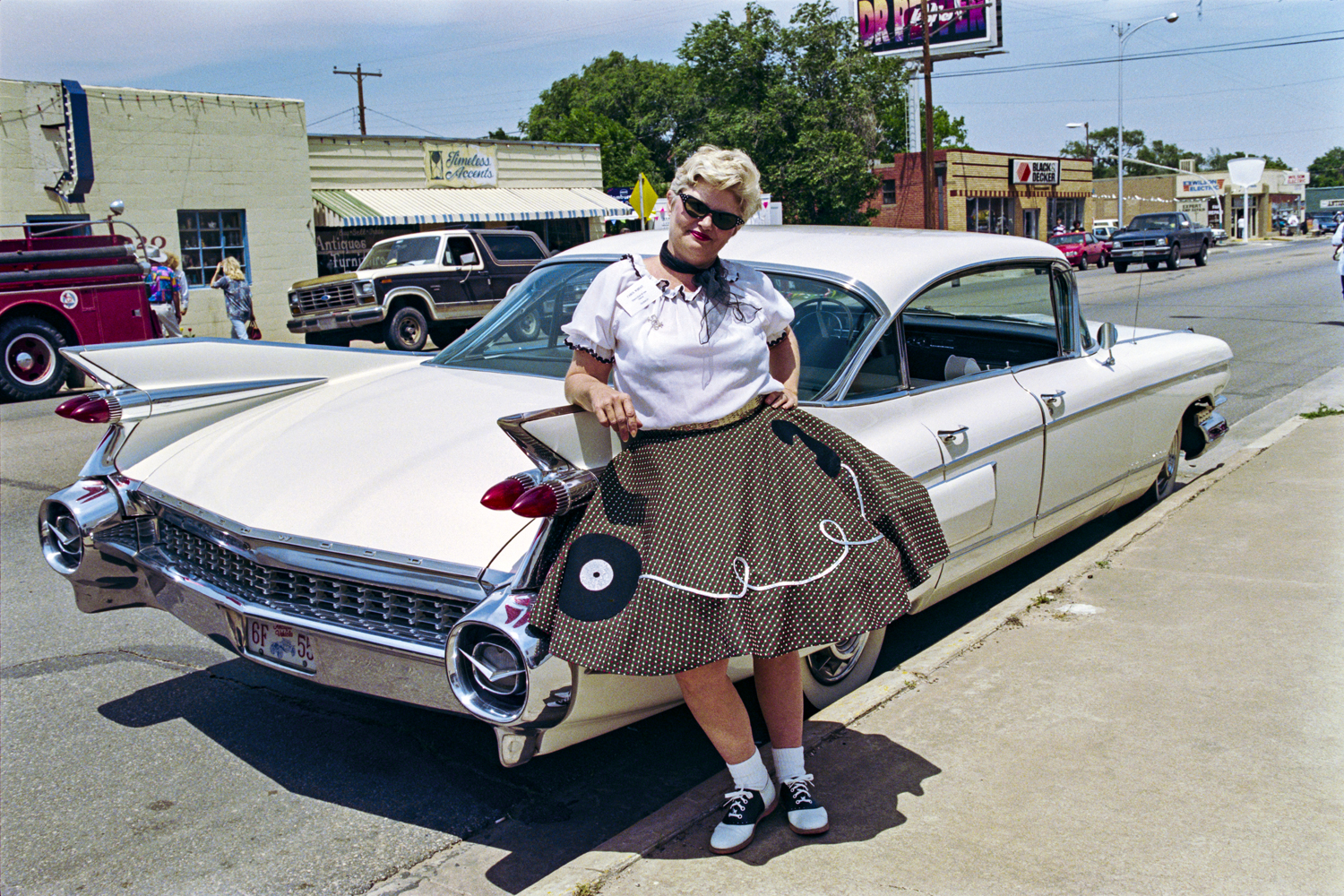
Elsewhere, another Cadillac appears, its owner displaying short blond hair in the style of Kim Novak. The 1959 model – l’épée, as the French nickname these long cars, les belles américaines – still holds an industry record: the longest tail fins ever built, each crowned with double, bullet-shaped headlights.
A sea of electricity poles stretches across the land, all wood, each crowned with horizontal crossbars. There are 180 million electricity poles in the United States – enough for every American to claim half a pole. In the same frame, a suggestive shape emerges: the outline of a rabbit. An image of unchecked reproduction – wooden poles multiplying without end, yet another American landscape.
Then, suddenly, in the Mojave Desert: Bagdad Café. Or rather, an advertisement announcing that the cult film Bagdad Café – inspired by the novel of the same name – was shot there in the 1980s, in Newberry Springs, a settlement crossed by Route 66. Bagdad itself was a village eighty kilometres away, now a ghost town, reduced to a dry tree and sun-bleached caravans. Fiction has reinvented itself as reality. Bagdad and the original Bagdad Café no longer exist; in Newberry Springs, the café used for filming survives as a site of memory and a tourist attraction.
A truck appears between two canyons. A Joshua tree – mythical, solitary. And a fake Elvis, shirt open, hair slicked with Brylcreem.
The lunar landscape that follows is unforgettable: ten American cars aligned in the desert, buried in sand up to their windshields. Three artists placed them there, arranged like the Pyramids of Giza. Bruce Springsteen wrote a song about it – Cadillac Ranch. A great photographer travels to tell stories we think we know, and others that resist explanation.
It all ends in Santa Monica: an oily competition of sculpted muscles, the great annual gay parade of Los Angeles.
Ferreira Fernandes
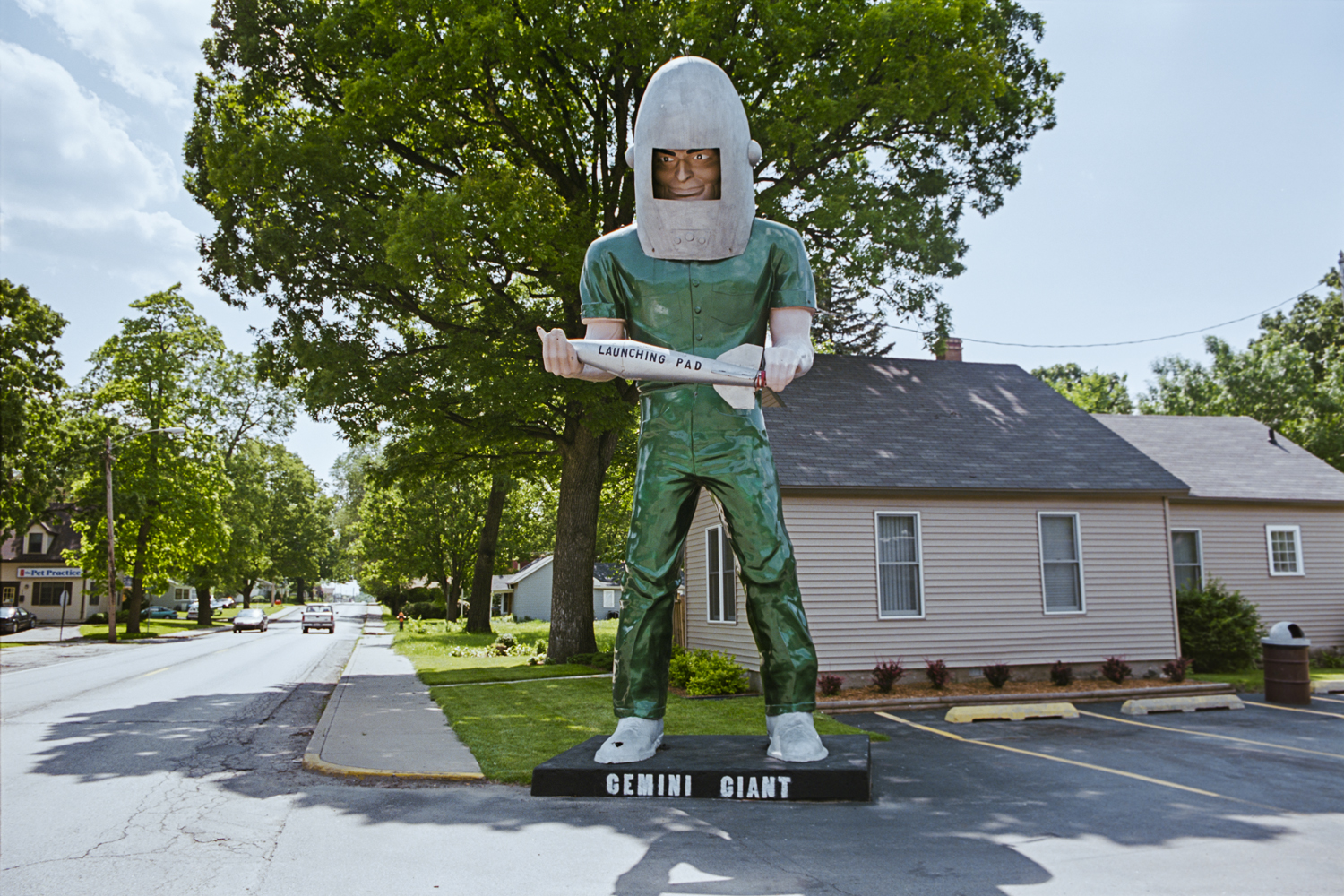
Lumina comes from the Latin word lumen, which evokes light, clarity and discovery. Lumina Galeria was born from this brilliance and the desire to reveal stories that light draws, opening a space where the gaze lingers and photography finds a place to breathe. To begin this journey, we chose a legendary route: Route 66, a project created in 1995 by Luís Vasconcelos.
Inspired by Jack Kerouac's On the Road and accompanied by the soundtrack of Bagdad Café, Vasconcelos set off from Chicago at the wheel of a Pontiac Catalina, accompanied by three friends, towards the endless horizon of the ‘Mother Road’. It was almost 4,000 kilometres, crossing eight states, endless deserts and small towns suspended in time, where America still seems to live in a dream made of dust, neon and open skies. His images transport us to this mythical territory, where road, freedom and travel intersect, leading us, almost without realising it, into a narrative that is both geographical and emotional.
In this first exhibition by Lumina, the walls that were once silent now echo with the cadence of a journey lived behind the wheel and to the rhythm of chance. Between desolate landscapes and unlikely encounters, we come across a rockabilly girl, a roadside Elvis and a gay parade in Los Angeles, in a succession of moments that seem to belong to cinema, music and dreams, all at the same time. More than just opening a space, we are celebrating an author who, in addition to a distinguished career in photojournalism, has built a deeply personal body of work, marked by memory, everyday life and humanism. Here, each photograph ignites a spark of travel and reminds us that light, when it finds those who know how to see it, can transform the world into a path. And for those who wish to extend the journey, it is possible to take home a fragment of that dream, preserved in paper and light, to continue to be part of other landscapes and other lives.
Bruno Portela