The architecture of a flower
Paulo Canilhas
18.04.2026 :: 30.05.2026
Wednesday to friday 03:00 pm - 07:00 pm, saturday till 08:00 pm
The Architecture of a Flower
Paulo Canilhas
Between the constructed and the organic, a land of friction emerges. The architecture of a flower proposes the interpretation of urban space as a living, unstable territory in permanent negotiation.
This new series of works by Paulo Canilhas is born from the observation of discreet signs of life that lurk in the contemporary city: pervasive vegetation emerging in cracks, trees molded by architectural structures, organisms inhabiting the margins and residual spaces of the urban fabric. Often invisible within the city's organization, these forms reveal a latent dimension of the territory — a silent environment that coexists with the built infrastructure.
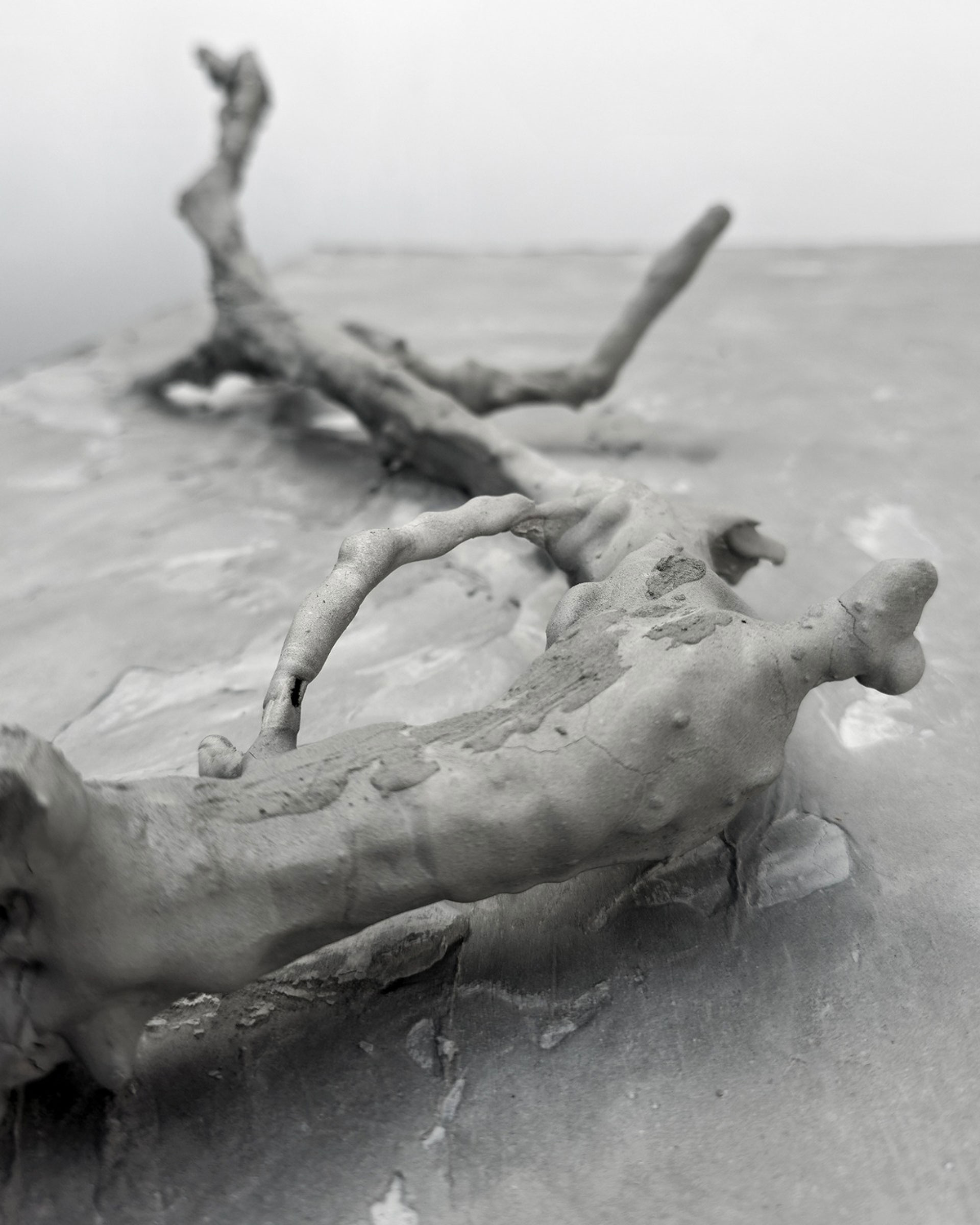
In these works, surfaces that evoke fragments of walls or architectural panels are transformed into sculptural reliefs with an almost archaeological quality. The material appears dense and stratified, marked by erosions, fissures, and inscriptions that refer to the functional grammar of the city: numbers, acronyms, and codes that guide and organize the urban space.
By moving these signs into the sculptural medium, Canilhas suspends their utilitarian function and transforms them into vestiges. The pieces appear as fragments of a fossilized urban landscape, in which architecture reveals itself as both structure and ruin, memory and a surface for inscription.
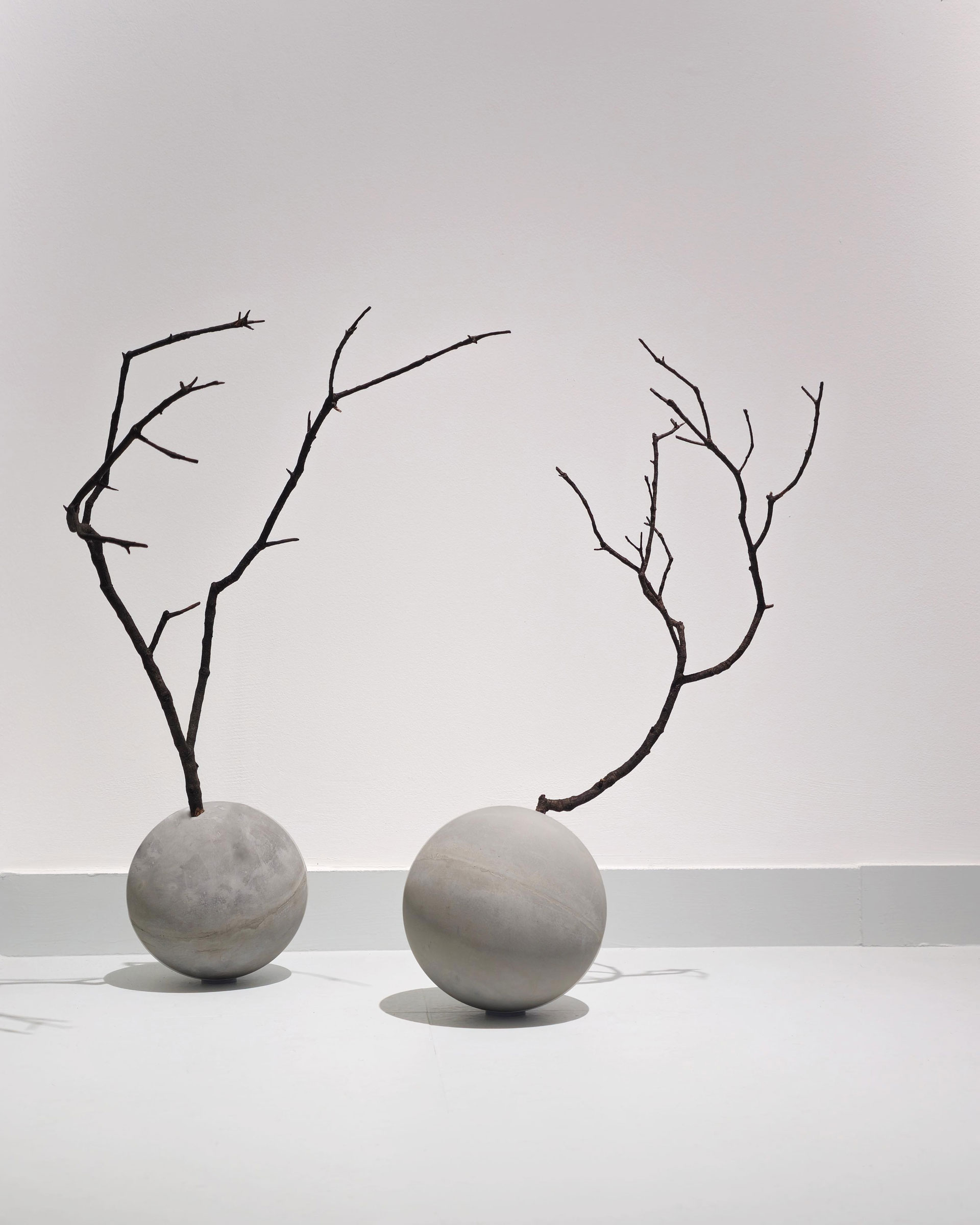
It is in this context that branches appear — minute plant forms that cross or seem to emerge from the material itself. They are not naturalistic representations, but structural gestures that introduce another spatial and temporal logic into the work. Organic growth infiltrates the rigidity of the architecture, establishing a tension between what was designed and what grows unpredictably.
The materiality of the pieces also evokes an archaeological dimension: each surface seems to contain layers of time, as if the urban wall could be read as a stratum where gestures, marks, and transformations accumulate. In this context, nature appears less as an image than as a structural principle — a minimalist architecture that is inscribed in the material and subtly reconfigures the logic of the built space.
The wall, ceases to be a boundary or support. It becomes a field of sedimentation where different times intersect: the slow time of matter, the administrative time of the city, and the biological time of growth.
Between the mineral hardness of the wall and the fragility of the plant’s form, a field of tension emerges where the sculpture ceases to represent the world and instead becomes a meeting place for distinct forces: construction and erosion, order and growth, permanence and transformation.
The architecture of a flower thus shifts the gaze onto the urban territory. The city is no longer understood solely as an organized system, it reveals itself as a landscape in progress — a space where the constructed and the organic coexist in continuous negotiation.
If architecture defines and organizes, nature introduces deviation.
If the wall stands firm, growth breaks through.
It is in this encounter — between urban form and the force of life — that the work reveals a latent possibility within the territory: that even in the most rigid matter, the possibility of transformation always persists.